 On The Mend
Men's health often gets overlooked. GP Dr Geoffrey Kimanje on the checks that change with age, the signs someone might be struggling, and the small changes that add up.
With Dr Geoffrey Kimanje, who practises at Chelsea Arcade Medical
Men's health often goes to the bottom of the list. In this episode of On The Mend, GP Dr Geoffrey Kimanje talks about why that happens and how to start the conversation, beginning with the everyday checks worth knowing about.
He covers how those checks change with age, from a regular blood pressure check when you are younger to free bowel cancer screening from age 45, the signs that someone might be struggling, and the small changes that add up over time.
Dr Geoffrey Kimanje is a GP at Chelsea Arcade Medical in Chelsea, Victoria. He joins Episode 2 to talk about men's health, the checks that change with age, and starting conversations about wellbeing.

Why Australia sees so much skin cancer, how to protect your skin, what the SCAN self-check looks for, and what happens in a professional skin check.
With Dr Ross Wines, who practises at Chelsea Arcade Medical
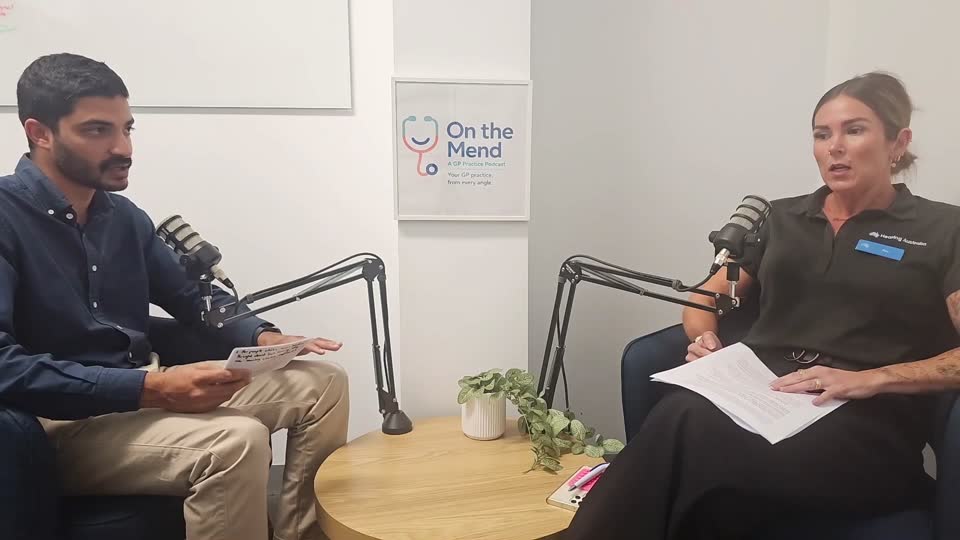
Why hearing checks matter, the early signs of hearing loss people overlook, headphones and young ears, and the support Hearing Australia provides.
With Rebecca Bourke, Community Service Advisor at Hearing Australia
A lightly edited transcript of the conversation with Dr Geoffrey Kimanje. General information only, not personalised medical advice. See your GP about your own health. If you or someone you know is struggling, speak with your GP, or call Lifeline on 13 11 14.
Host: Welcome, everyone. Joining us today on On The Mend is Dr Geoffrey Kimanje from Chelsea Arcade Medical. Dr Geoffrey is a UK-trained GP who earned his membership of the Royal College of General Practitioners in 2023 before moving to Australia. He provides care across all areas of general practice, with a special interest in skin cancer medicine and early melanoma detection, and he does some travel medicine too. Welcome, Dr Geoffrey.
Dr Geoffrey Kimanje: Thank you, nice to meet everyone. I am hoping to provide some useful information today.
Host: We are excited to have you. Today I would like to talk about men's health. There is a lot out there about women's health, lots of appointments and checkups, but we do not talk as much about what is available for men. From your perspective, what is men's health and what does it include?
Dr Geoffrey Kimanje: That is a fair question. Men's health covers the general wellbeing of men, which includes their mental health and their routine health, and it spans all stages of life, from young people through to the elderly. It takes in many factors: musculoskeletal, cardiovascular, skin cancer screening, and so on, depending on a person's risk factors.
Host: Things like mental health are not specific to men, but they need to be raised and spoken about.
Dr Geoffrey Kimanje: Absolutely, because it comes along with, and integrates with, so many other conditions. It is very relevant.
Host: From your experience, what do men find hardest to discuss in consultations?
Dr Geoffrey Kimanje: I would go back to mental health. This is one of the things men find very difficult to bring up, partly because of the pressure in society for men to appear strong and self-reliant. Bringing it up can feel like showing weakness, which is not actually true, but that makes it the most difficult thing to raise.
Host: For men specifically, what checkups and health checks can help us stay healthy?
Dr Geoffrey Kimanje: If I narrow it down, I would focus on the things that cause a lot of health issues in men, because in Australia men live on average around four to five years less than women, and many of the reasons are preventable if they present earlier. Those include a routine blood pressure check, cancer screening, including bowel screening, and skin checks depending on occupational exposure. And mental health is very important throughout. It varies by age: for younger men, ideally a blood pressure check about once a year and a skin check depending on occupation. As men grow older, and depending on risk factors, routine blood tests to look at cholesterol and blood pressure, and keeping up with cancer screening.
Host: And a lot of this can come down to family history and things that are hereditary.
Dr Geoffrey Kimanje: I agree. Family history raises the threshold for when to investigate, and it helps decide what a particular patient needs so they get the right care.
Host: Blood pressure, cardiovascular health, diabetes, those can be passed down. But can something like mental health be passed down?
Dr Geoffrey Kimanje: I would not say passed down in the sense of being hereditary. What I would say is there are risk factors that can lead to poorer mental health in a family. For example, if parents are already struggling, they may not have the capacity to fully care for their children, who can then be affected. As we often say, if you do not take care of yourself, it is hard to take care of others. So it is more a risk factor than a hereditary problem.
Host: Like a domino effect. If you cannot look after yourself, and you are not setting that example, how will your kids learn it? My own dad was reluctant to go to the doctor when we were young. Now that he is older and seeing his children grow, he is more involved and more proactive about his blood pressure and cardiovascular health. I am hoping to be preventative rather than reactive, and pass that on to my own children.
Dr Geoffrey Kimanje: I agree, and this is why things like this podcast matter. The more information people have, the more empowered they are to make good decisions about their health. With more insight, people tend to be more proactive in seeking help.
Host: You mentioned bowel cancer screening. Is that only from a certain age, or should men do it younger?
Dr Geoffrey Kimanje: I was referring to the National Bowel Cancer Screening Program. It is now available from age 45, with a screening test every two years. Risk generally increases as people get older, but that does not mean younger people should not get health checks. We do occasionally see these things happen in very young people. The basic advice is: if you are worried about something, or something has changed and your instinct tells you something is not quite right, see a doctor rather than letting it be.
Host: Even a basic blood test to check things are functioning as they should.
Dr Geoffrey Kimanje: Yes. If you discuss it with your doctor, they can assess your risk, work out what is needed, and give you the best advice to get the right help.
Host: Coming back to mental health, what are some signs that men might be struggling that they may not directly tell you about?
Dr Geoffrey Kimanje: Good question. Because men often present as strong, it can create a barrier, and they may present quite differently from what we think of as textbook depression. Some of the signs are withdrawing from things they would normally enjoy, which we call anhedonia, poor sleep, difficulty maintaining relationships, and irritability or anger, alongside low mood. If you notice those cues and explore a bit more, you can often find that someone is struggling, and then you can offer the right help.
Host: Signs like leaning more on alcohol as well.
Dr Geoffrey Kimanje: Yes. Alcohol is a big one. People think it gives a short break from what is happening around them, but that small, short-lived effect can lead to bigger problems over time.
Host: If someone wanted to improve their health with just a few changes, where can they start?
Dr Geoffrey Kimanje: The simple steps make the biggest difference. You do not have to do anything fancy. Look at the risk factors, like weight. Eating healthily and being active matter. The general recommendation is around 150 minutes a week of exercise, and you do not have to do it all at once, you can spread it out. When people lose weight, many risk factors, even for difficult conditions, tend to come down, and sometimes you do not end up needing medication for certain things. These small changes can make huge differences.
Host: I work in an office, so I need to set aside time to be active. But does physically demanding work, like trades or warehouse work, count as exercise?
Dr Geoffrey Kimanje: It is physical activity, but it is not necessarily cardiovascular exercise if it is not focused. You can work physically and still have other lifestyle habits that are not ideal, or the work might just involve lifting or bending without really working your heart. Focused exercise, the kind that makes you sweat and gets your heart going, with a goal of improving your body, is different from the goal of simply finishing a job. So in some ways it might not count the same way.
Host: Men's health really encompasses all parts of health, including social health.
Dr Geoffrey Kimanje: That is right. Spending time with the right people, staying connected with family rather than isolating yourself, eating well, it all adds up. It is a comprehensive thing, not just one factor. Even talking about a relationship issue, with a parent, partner or children, can bring about beneficial changes. Family encourages you, and that push can make a difference. It is good for the person and good for society.
Host: That is great. Dr Geoffrey, we will have to get you back to go into some of these topics in more detail. Thank you for joining us today, and thank you, listeners, for tuning in. Until next time, stay well and keep on the mend.
Subscribe on YouTube or follow On The Mend to catch each new episode and clip.
Watch on YouTube